
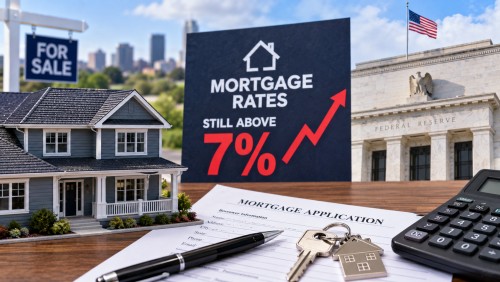
Homebuyers in the United States are facing heightened financial pressure as mortgage rates continue to exceed 7%, a trend exacerbated by the Federal Reserve’s recent decision to raise interest rates. The increase in borrowing costs is making home ownership more challenging for many Americans, as the average 30-year mortgage rate has surged to 7.37% as of September 17, 2026. This marks a significant climb from the 5.75% rate recorded in March, directly impacting monthly payments for prospective buyers.
The Federal Reserve’s latest interest rate hike, which raised its target range to 3.75%–4%, is a response to persistently high inflation levels, which remain above the central bank’s 2% target. However, mortgage rates are not solely dictated by the Fed’s policies; they are also influenced by broader financial market conditions, inflation expectations, and investor demand. Consequently, while the Fed’s actions contribute to the rising trend, they do not directly equate to an immediate increase in mortgage rates.
Despite the challenging landscape, some borrowers might still find opportunities to secure lower rates depending on factors such as credit scores, down payments, and specific lender terms. Options like paying mortgage points upfront can also help reduce interest rates, although this requires higher closing costs. Additionally, adjustable-rate mortgages offer an alternative, though borrowers should be aware that these rates can change after the initial fixed period.
The refinancing market has also felt the impact of rising rates, with the average 30-year refinance rate hitting 7.41% and 15-year refinance rates reaching 6.75%. For homeowners with existing loans at lower rates, refinancing becomes less appealing unless the long-term savings justify the associated costs.
Looking ahead, the future trajectory of mortgage rates will be closely tied to inflation trends, economic conditions, and further policy decisions by the Federal Reserve. While there remains a possibility for rate adjustments, there is no certainty that waiting will lead to more favorable borrowing conditions.