
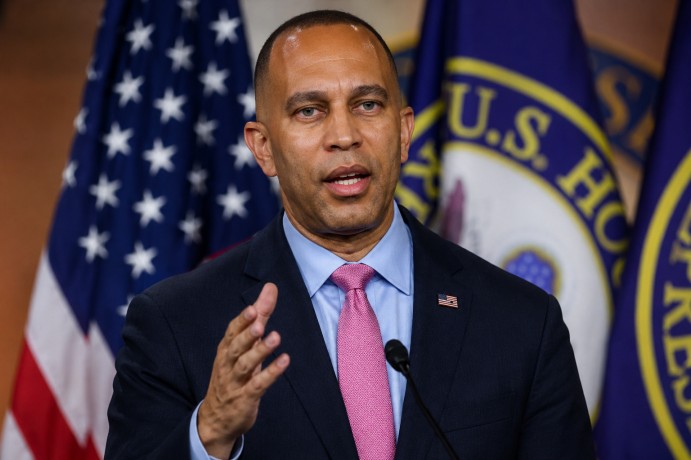
In a significant development reflecting internal divisions within the Democratic Party, senior House Democrats have committed to voting against a proposal that seeks to halt $3.3 billion in U.S. aid to Israel. This opposition arises amidst ongoing debates over the United States’ support for Israel, particularly in light of the conflict in Gaza. House Minority Leader Hakeem Jeffries has expressed his disapproval of the amendment, introduced by Republican Representative Thomas Massie, labeling it as “overly broad.” Jeffries voiced concerns that the proposal might inadvertently impact humanitarian aid and undermine efforts to counteract militant organizations like Hamas and Hezbollah.
House Democratic Caucus Chair Pete Aguilar has joined Jeffries in opposing the proposal, while also acknowledging the need to reassess the U.S.-Israel relationship. Aguilar pointed out that Israel’s current policies have led to increasing regional isolation, indicating a shift in the dynamics between the two nations. This stance highlights the growing call within the party for a reevaluation of longstanding foreign policies concerning Israel and its neighbors.
On the other hand, the amendment has found support from Congressional Progressive Caucus Chair Greg Casar. Casar has called on lawmakers to back the proposal, arguing that U.S. taxpayer dollars should no longer support Israel’s military actions. He advocates for a revised approach by the Democratic Party towards the Israeli-Palestinian conflict, which would reflect changing sentiments among voters and progressive members of Congress.
The discussion takes place against a backdrop of increasing pressure from progressive lawmakers and constituents demanding a shift in U.S. policy regarding Israel. This growing sentiment is fueled by the ongoing conflict in Gaza, which has intensified calls for a change in how the U.S. engages with the region. As part of this discourse, Jeffries has called for a “major reset” in U.S.-Israel relations, emphasizing the importance of supporting Israel’s right to exist while simultaneously advocating for the establishment of a Palestinian state.
Jeffries also suggested that future U.S. military assistance should align with human rights standards and consider Israel’s capability to independently fund more of its defense needs. This perspective underscores a potential pivot in U.S. foreign policy, balancing strategic support with ethical considerations and fiscal responsibility. As these discussions continue, they mark a pivotal moment in the Democratic Party’s approach to international relations and foreign aid.