
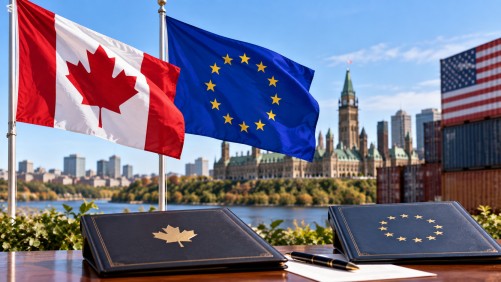
Canada is set to diversify its international alliances by pursuing a unique security and economic partnership with the European Union (EU), a move that could reshape its trade landscape amid ongoing tensions with the United States. Canadian Prime Minister Mark Carney announced this strategic shift at the Canada Investment Summit in Toronto, emphasizing the need for economic resilience through expanded global partnerships.
Under this new approach, Canada and the EU plan to enhance their collaboration in several strategic sectors, including defence, critical minerals, artificial intelligence, energy, technology, and financial services. This initiative aims to build upon the existing Comprehensive Economic and Trade Agreement (CETA) and further strengthen the trade relationship between the two regions. Notably, Canada is the only non-European participant in the EU’s defence procurement initiative, signaling its commitment to an expanded alliance.
As part of the broader effort to attract investment, Canada announced nearly C$500 billion in new commitments from various sources, including pension funds and financial institutions. The government also unveiled a new Productivity Mega Deduction, designed to enable businesses to more quickly recover the costs of a wide array of investments, thereby stimulating economic growth.
In an additional bid to boost private investment, Carney revealed plans to engage private entities through long-term concessions for operating Canada’s four largest airports, while maintaining federal ownership of the assets themselves. This approach reflects a strategic investment model aimed at improving infrastructure without relinquishing public control.
Despite these efforts to diversify its international partnerships, Carney acknowledged that the United States remains a crucial economic and strategic partner for Canada, given the proximity and strong economic ties between the two nations. However, by enhancing ties with the EU, Canada seeks to mitigate risks associated with relying too heavily on a single partner.
As discussions between Canada and the EU progress, both parties are focused on defining the scope of their enhanced partnership. The ongoing negotiations aim to bolster trade, investment, security, and strategic supply chains, paving the way for a more resilient and diversified economic future for Canada.