
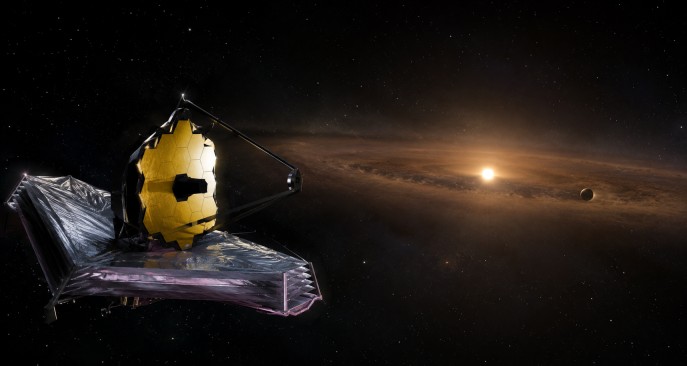
Astronomers have made a significant discovery with NASA’s James Webb Space Telescope, uncovering an exoplanet known as Beta Pictoris d that had remained hidden until now. This newly identified giant planet orbits the star Beta Pictoris, joining two other previously known planets in this well-explored planetary system.
Unlike its celestial counterparts, Beta Pictoris d was not found through direct imaging but was detected by its unique atmospheric chemical signature. This breakthrough was achieved using Webb’s Near-Infrared Spectrograph (NIRSpec) while scientists were studying another planet in the same system, marking an unexpected and exciting development in exoplanet research.
Scientists confirmed the existence of Beta Pictoris d by examining its atmospheric composition and movements, which revealed the presence of carbon monoxide, water vapor, and methane. Situated within a bright debris disk that had previously concealed it from traditional imaging methods, the planet is a massive body, at least twice the size of Jupiter, and orbits its star at a distance similar to Neptune’s from the Sun.
Located approximately 63 light-years from Earth, the Beta Pictoris system is an invaluable site for understanding the formation and evolution of planetary systems, being around 23 million years old. The identification of Beta Pictoris d marks the first instance of an exoplanet being discovered primarily through moderate-resolution spectroscopy. This novel approach offers a promising new avenue for detecting planets hidden in dusty environments, potentially transforming future searches for exoplanets throughout the Milky Way.