
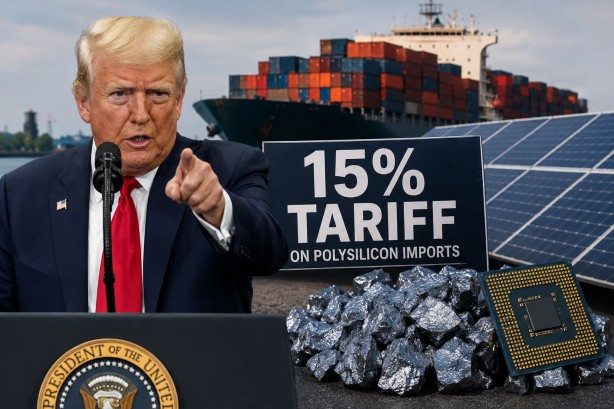
In a decisive move to bolster domestic production of key technological materials, US President Donald Trump has announced a 15% tariff on imported products made with polysilicon. This tariff, set to take effect on December 4, aims at reducing the United States’ dependence on China for this critical component, which is essential in manufacturing semiconductors and solar panels.
Polysilicon, an ultra-pure form of silicon, plays a pivotal role in the production of semiconductors that are integral to powering artificial intelligence systems and data centers. It is also a fundamental component in the creation of solar cells and panels. Currently, China stands as the leading global producer of polysilicon. The newly introduced tariff measures also establish minimum import prices: $21 per kilogram for polysilicon, $100 per kilogram for polysilicon ingots and wafers, along with $0.22 per watt for solar cells, and $0.38 per watt for solar modules and panels.
The US administration has articulated that these measures are designed to enhance the commercial viability of domestic polysilicon production and to fortify critical supply chains that are linked to both economic and national security interests. In response to this development, China has issued criticism, accusing the US of exploiting national security concerns to unfairly restrict Chinese businesses and cautioning that such protectionist measures could potentially disrupt trade between the two nations.
Within the United States, there are currently two major polysilicon production facilities. These are operated by Hemlock Semiconductor in Michigan and Wacker Chemie in Tennessee. The new policy framework also provides the US government with the capacity to establish incentives to encourage companies to invest in domestic polysilicon and related manufacturing facilities. This strategic move comes at a time when China continues to demonstrate robust growth in exports, especially in sectors such as electronics, artificial intelligence-related products, and other high-value manufacturing industries.